


FlowStop put to the test: test protocols and results
An independent test by the National Research Council Canada, tank tests, weight resistance and impact. For each test: who ran it, under what conditions and what was measured.
FlowStop tested by the National Research Council Canada
Between October 2024 and January 2025, the NRC measured leakage on 16 door and window protection products, including three FlowStops: rising water, 22-hour immersion, waves and debris impact. The NRC installed the products according to their instructions and measured the leakage itself.
FlowStop results at a glance
10 times below the ANSI/FM 2510 leakage threshold
On a door, in static water, FlowStop leakage stayed below 0.0001 m³ per meter of seal per hour, the tank’s detection limit. The standard’s threshold is 0.001. Plywood: 1.2. Sandbags: 19.
Source: NRC report, table A.1The easiest installation in the study
Rated 1.25 on a scale from 1 (easiest installation) to 5 (hardest), tied with plywood and a freestanding barrier. No tools, one person. Stop logs: 3.25. Sandbags: 3.5.
Source: NRC report, table 9No failure reported
During the protocol, the sandbags were overtopped, a freestanding barrier was torn away by a wave and a flood door gave way on impact. The report notes no failure of the FlowStops.
Source: NRC report, pp. 62–69The test protocol
58.5 cm of water held for 22 h, irregular waves up to 15 cm, impact from a 277 kg log at 1 m/s (140 J), then flood raised to 80 cm for 1 h.
Source: NRC report, table 6FlowStop vs stop logs
| Criterion | FlowStop | Stop logs | Fixed-frame wall | Metal window panel | Adhesive window protection | Freestanding barrier | Flood door | Plywood | Sandbags |
|---|---|---|---|---|---|---|---|---|---|
| Opening tested | Door and window | Door | Door | Window | Window | Door | Door | Window | Window |
| Attachment to building | None | Permanently fixed C-channels and sill plate | Frame glued on the sides and sill, panels on brackets | Permanent frame glued to the facade, 14 fixing points | Plate glued onto a screwed wooden frame | Inflatable seal, adhesive sealant at the sill and corners | Replaces the existing door | Nailed to the facade (16 nails) | None (stacked bags) |
| Installation time (1 to 5) | 1 | 3 | 3 | 2 | 2 | 1 | 5 | 1 | 5 |
| Expertise required (1 to 5) | 1 | 4 | 5 | 3 | 5 | 2 | 5 | 2 | 2 |
| People needed (1 to 5) | 1 | 2 | 1 | 1 | 2 | 1 | 3 | 1 | 5 |
| Clarity of instructions (1 to 5) | 2 | 4 | 4 | 1 | 2 | 1 | 5 | 1 | 2 |
| Average installation rating | 1.25 | 3.25 | 3.25 | 1.75 | 2.75 | 1.25 | 4.5 | 1.25 | 3.5 |
| Max. leakage in static water (m³/m/h) | ≤ 0.0001 (door) 0.00064 (window) | 0.00045 | 0.0091 | 0.00013 | 0.0039 | 0.023 | 0.11 | 1.2 | 19 |
| Observed behavior | No failure reported | Leakage through bottom seals* | Leakage through bottom seals* | Minimal leakage at start of test | Steady trickle through the frame* | Torn away by a wave | Gave way on impact | Leakage increasing with water depth | Overtopped from the start |
Ratings from 1 to 5 assigned by the NRC, 5 being the most demanding (table 9). Leakage: highest value in static water between 28.5 and 58.5 cm of water (table A.1). ANSI/FM 2510 threshold: 0.001 m³/m/h. * Tested in the NRC ice tank: static water and debris impact, no waves. Third-party products are identified by type; their names appear in tables 4 and 9 of the report.
See NRC test detailsHide details
Report reference
- Title
- Performance of Home of Flood Resiliency and Flood Retrofit Measures
- Number
- NRC-OCRE-2025-TRQ-005, revision 1.6, July 2, 2025
- Authors
- Louis Poirier, Jacob Stolle, Paul Knox (NRC Ocean, Coastal and River Engineering)
- Sponsor
- Architecture Sans Frontières Québec, with the Canada Mortgage and Housing Corporation
- DOI
- 10.4224/40003479
The NRC did not certify or recommend any product. Results are taken from the report, with the original page or table.
Wave tank protocol
| Series | Load | Parameters | Duration |
|---|---|---|---|
| A | Rising water | Steps at 20, 28.5 and 58.5 cm | 58.5 cm held for 22 h |
| B | Irregular waves | Significant height 5, 10 then 15 cm, period 2.5 to 3 s | 40 min per sea state |
| C | Debris impact | 277 kg log, Ø 30 cm, 1.0 m/s (140 J) | then 8 h 45 min at 58.5 cm |
| C | Maximum flood | Level raised to 80 cm | 1 h |
Depths measured from the tank platform; the opening sills are 15 cm higher. Leakage collected in trays and weighed tanks, recorded every 15 minutes. Detection limit: 0.0001 m³/m/h.
Maximum leakage measured in static water
m³ per meter of seal per hour, highest value between 28.5 and 58.5 cm of water, logarithmic scale. Third-party products are identified by type; their names appear in table A.1 of the report.
What else the report finds
- Result. In the wave tank, both FlowStops on doors had negligible leakage for most of the protocol (p. 63).
- Limitation. The 90 cm cushion only covered the lower part of the door: in the largest waves, water went over the top (p. 63). The full-height cushion was not overtopped.
- Limitation. On a window, in the ice tank, leakage from the full-height cushion exceeded the ANSI threshold at times, during filling and around the impact (p. 69). Its maximum in static water, 0.00064, remains below the threshold.
- Limitation. Significant movement of the full-height cushion was observed, but not measured (p. 72).
“The two FlowStop barriers had negligible leakage rate for the majority of the protocol”
Study limitations, according to its authors
- One run per protection: repeatability could not be assessed.
- Installed by NRC staff following the instructions, without the manufacturer present.
- Openings lined with a smooth membrane, possibly more favorable than real masonry.
- 140 J impact, lower than the 600 and 800 J of the ANSI/FM 2510 standard.
Our other tests
Factory tank test in Boston, USA
- Static water, 70 cm, for 24 hours
- The first FlowStop made in the USA90 cm wide, 80 cm high, no straps
- No leakage observed


Tank test at a testing center in Elne, France
- 65 cm of water
- 3rd generation FlowStop275 cm wide, 100 cm high
- 50 kg log dropped from 1.22 mAbout 4.9 m/s at impact, i.e. about 600 J: the energy of the first impact in the ANSI/FM 2510 standard
- Less than 1 liter of leakage per hour, before and after the impact
Weight resistance test in Cape Coral, Florida
- A pickup truck drives over an inflated FlowStop2,500 kg vehicle
- Pressure of 15 PSI before and 14.8 PSI after the vehicle passed
Partner tank test in Boise, USA
- Flash flood (0 to 70 cm in 20 min) and waves
- 2nd generation FlowStop275 cm and 90 cm wide, 80 cm high, 2 straps along the length
- No leakage observed
Impact resistance test in Oldsmar, Florida
- 2 kg wooden plank dropped from 5.8 mAbout 10.7 m/s at impact, i.e. about 114 J
- No pressure loss and no marks on the PVC after impact
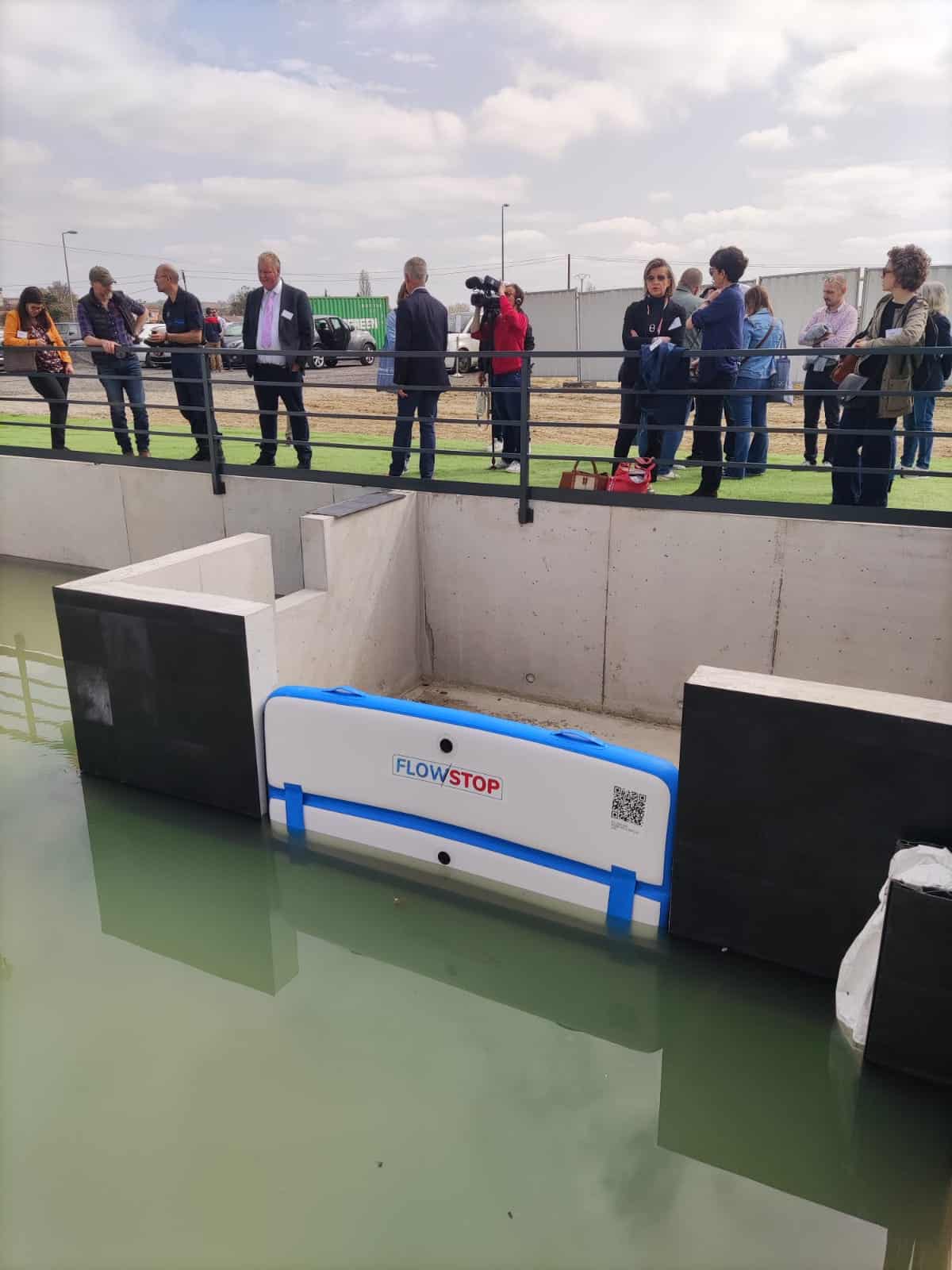
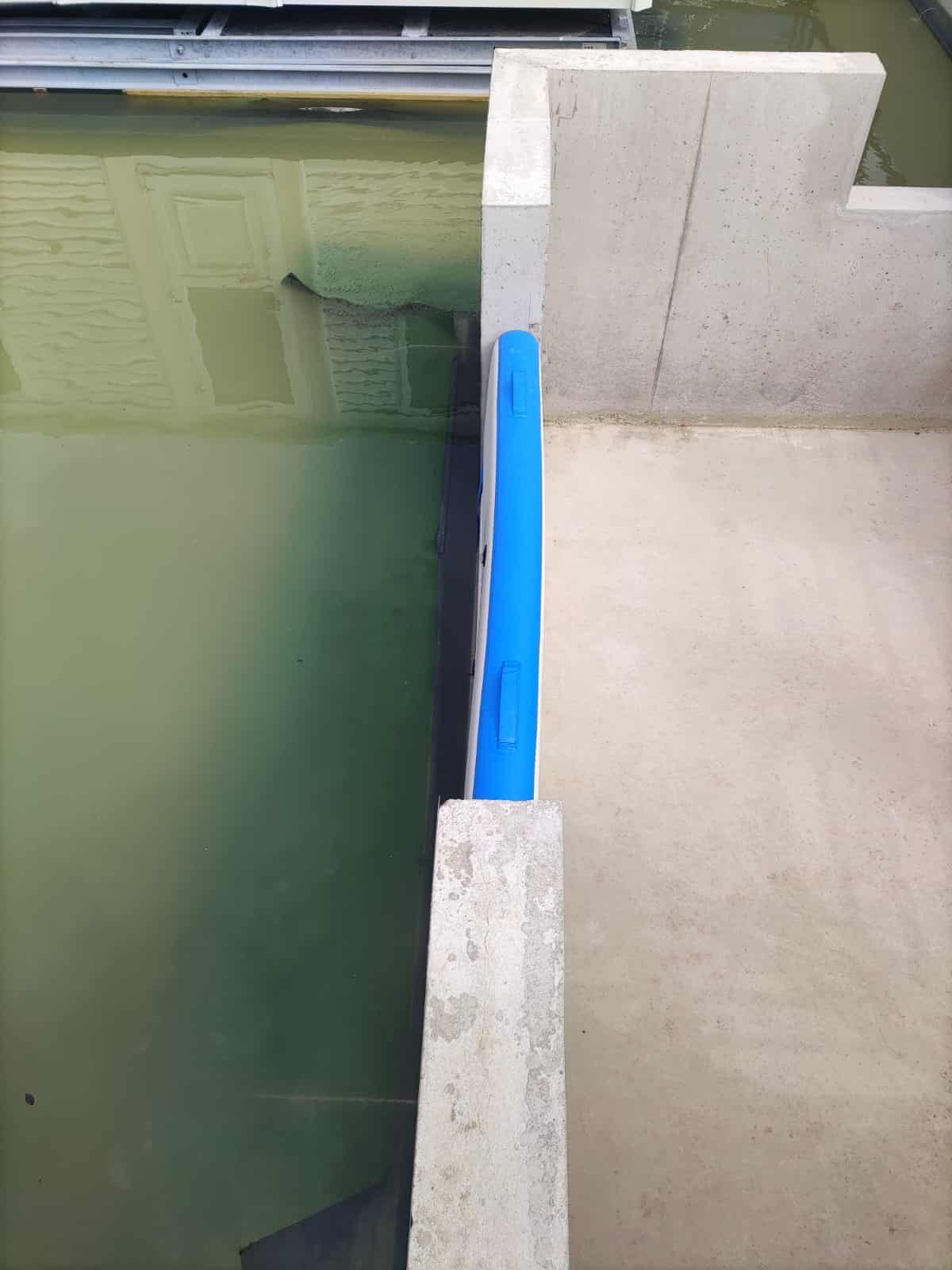
Baziège flood testing center
- 1st generation FlowStop200 cm wide, 80 cm high
- Device installed in an opening that replicates a picture window
- Water depth: 20 cm
- No leakage
FM Approvals certification: in progress